StudyDeck

Price

Exam code: 7115
Written by: Ashika|Reviewed by: Caroline Carroll|Updated 2 July 2026

Introduction to pricing methods

Introduction to pricing methods

  • Choosing the right pricing method is essential for a business to be profitable, competitive, and successful in the long run

  • By understanding their customers, competitors and costs, businesses can set prices that maximise sales revenue and profits

  • Pricing can play a significant role in the market positioning of the brand and help a firm to compete with rivals

Pricing methods
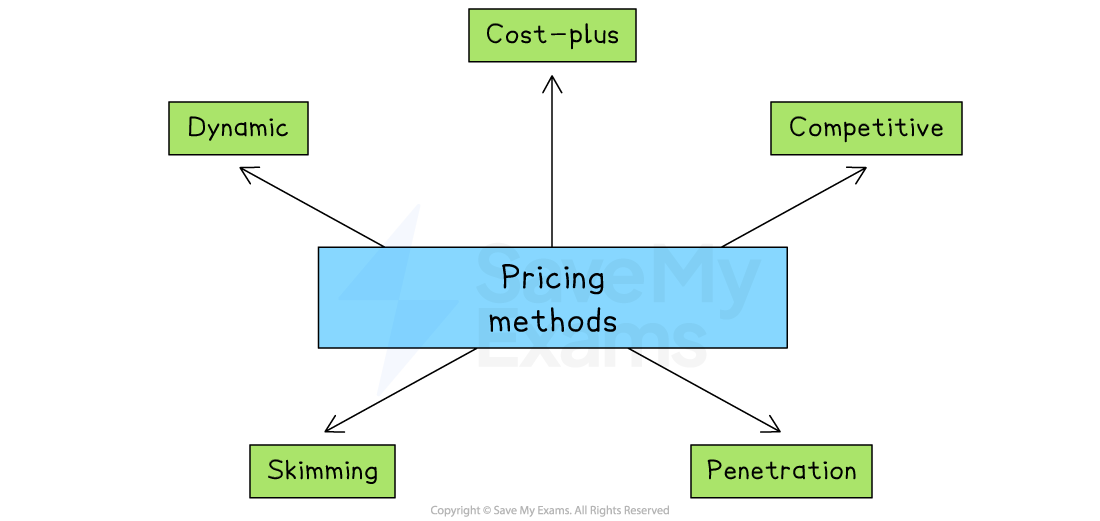
Diagram showing different pricing methods: Cost-plus, Dynamic, Competitive, Skimming, Penetration, all pointing to a central box labelled "Pricing methods".
Common pricing methods include cost-plus, penetration and skimming

Cost-plus pricing

Cost-plus pricing

  • The business calculates the cost of production and then adds a markup to determine the final price

  • The markup covers the cost of production plus the business's desired profit margin

  • This pricing strategy is simple and is commonly used by manufacturers that produce standardised goods, e.g., washing machines

Advantages

Disadvantages

  • A simple and quick method of calculating a price for a product

  • It ensures that a profit is made on each item sold

  • It does not consider the needs of the market 

  • Pricing methods of competitors are ignored

Competitive pricing

Competitive pricing

  • Competitive pricing is when a business sets its prices based on what its competitors are charging

  • It is common in markets where there are many similar products, and customers can easily compare prices

  • The goal is to attract or keep customers by offering prices that match or beat rivals

Advantages

Disadvantages

  • Helps the business stay competitive and protect its market share

  • Can attract price-sensitive customers who compare options before buying

  • Requires regular monitoring of competitors’ prices, which can be time-consuming

  • It doesn’t always reflect the quality or value of the product

Penetration pricing

Penetration pricing

  • The business sets a low price for a new product or service when it is first introduced

  • This is effective when a business wants to quickly capture market share and attract price-sensitive customers, e.g., many new perfumes launch using penetration pricing

  • Once they have enough customers, the business will start to raise the price

Advantages

Disadvantages

  • Customers are attracted to buy the product at a low price, leading to high sales volume and market share

  • Competitors unable to match or beat the low price are forced out the market, leading to less competition

  • Customers may perceive that the product is of low quality if the product is sold at a low price

  • Selling at a low price limits the amount of profit made

Skimming

Skimming

  • Setting a high price for a new product or service when it is first introduced to the market

  • The price is gradually lowered to ensure sales continue

Advantages

Disadvantages

  • Works well for strong brands launching new, in-demand products (e.g. Apple)

  • High prices at launch help quickly recover research and marketing costs

  • It is only suitable for well-known brands with loyal customers

  • Customers may get tired of high prices and switch to cheaper competitors

Dynamic pricing

Dynamic pricing

  • Continuously adjusting prices in real time to reflect demand, supply and other conditions

  • Uses algorithms and data, such as time of day, inventory levels and competitor prices

    • For example, Uber raises fares during times of peak demand and lowers them when demand falls

Advantages

Disadvantages

  • Prices go up when demand is high and fall when demand is low, helping to keep income steady

  • Businesses like airlines or ride-sharing apps can charge more during busy times to make sure seats or cars go to people who really want them

  • Customers may feel upset if prices rise suddenly, which can damage brand trust

  • It relies on advanced technology and constant monitoring, which can be costly and hard to manage.

Recommending a suitable pricing method

Recommending a suitable pricing method

  • A business should carefully consider a range of factors when deciding on an appropriate pricing method

Factors to consider when choosing a pricing method

Factor

Explanation

Example

USPs and differentiation

  • Products with more unique features can often be sold at higher prices

  • Dyson vacuum cleaners have special features that allow premium pricing

Technology

  • Online platforms have enabled new pricing models, like offering a free product with paid upgrades

  • Farmville is free to play but users pay for extra features, creating high profit margins

Level of competition

  • In very competitive markets, businesses may have to set lower prices to attract customers

  • Budget airlines keep prices low to compete for demand in a crowded market

Strength of the brand

  • Well-known brands with loyal customers can usually charge more for their products

  • Nike can charge premium prices because of its strong global brand

Stage in the product life cycle

  • Prices often change as the product moves through its life cycle

  • It may be lower at launch, higher during growth and lower again at maturity

  • Samsung often reduces the price of its older Galaxy phone models once newer versions are released

Costs and the need to make a profit

  • Prices should cover all costs and allow the business to make a profit

  • The Ivy sets menu prices to cover high-quality ingredients, experienced chefs, elegant décor and central city rent