Production Processes: Productivity & Efficiency
Labour productivity
Labour productivity
Production is the act of adding value to the factors of production to create goods and services e.g. using tomatoes and basil to create a soup
It is the process of converting the factors of production into goods/services
It is a measure of output e.g. 3 cans of soup
Productivity is a measure of efficiency that calculates the amount of outputs produced per unit of input
It calculates how efficiently resources are being used in the creation of goods/services and aids comparison of performance e.g. after training, workers proved to be 27% more efficient in their productivity
Labour productivity is calculated using the formula
The importance of efficiency
The importance of efficiency
Efficiency refers to the ability of a business to use its production resources as cost-effectively as possible
Efficiency is often measured in terms of the average cost per unit
The average cost per unit is calculated using the formula
Maximum efficiency is achieved when the cost per unit is at its lowest
Businesses that increase their level of productivity (e.g of workers or capital equipment) are likely to be more competitive
The benefits of improved efficiency
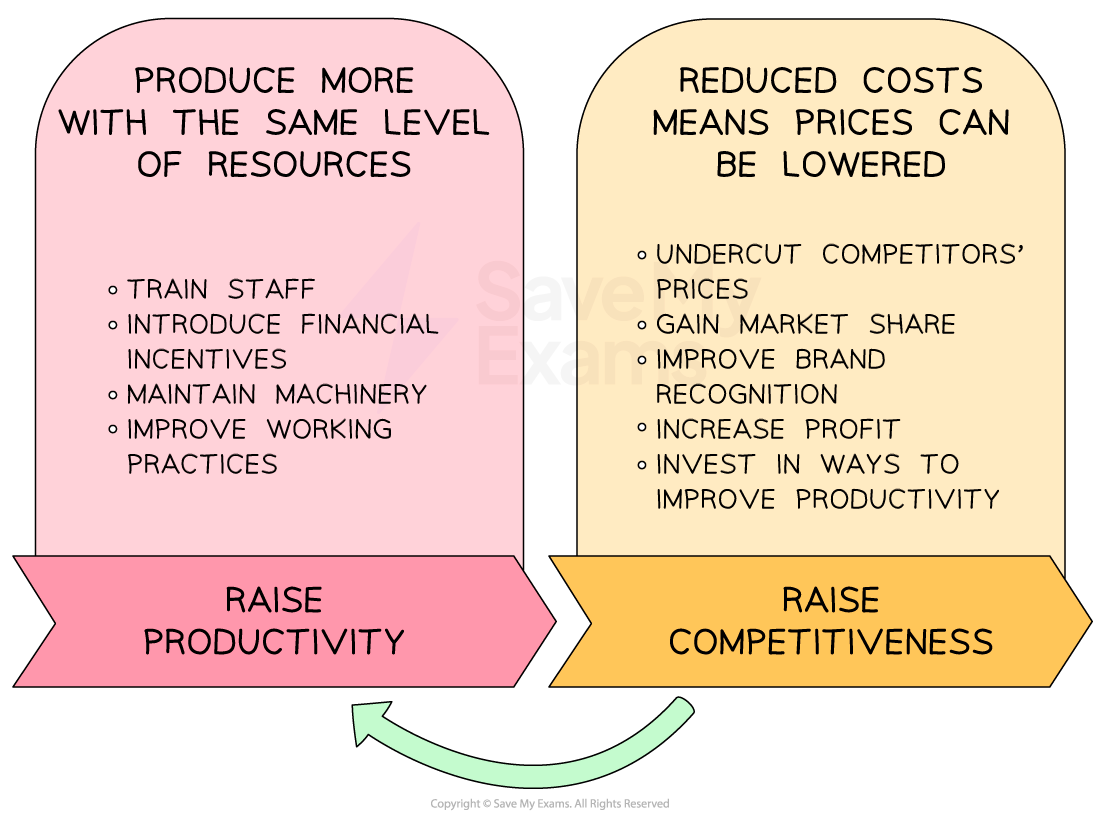
Businesses that are competitive usually generate more profit
This provides the financial resources to continue investing in improvements to their productivity
How to increase efficiency
How to increase efficiency
Increasing efficiency helps a business reduce costs, save time and improve productivity
Common ways to improve efficiency
1. Increasing automation
Automation uses machines or robots to carry out tasks that would normally be done by humans.
Production is likely to be faster and safer, with fewer errors and lower long-term labour costs
For example, car manufacturers use robotic arms for welding and assembling.
2. Introducing technology
Using new technology, such as computers or specialist software, can improve both manufacturing and service operations.
Technology often speeds up processes, reduces paperwork and improves communication and accuracy
For example, retailers using barcode scanners and stock management software to track inventory
3. Improving labour skills
Training employees helps them work more efficiently and safely
They produce better quality work, with fewer mistakes and more quickly
For example, a café training staff to use a coffee machine correctly to avoid waste.
4. Lean production methods
Lean production aims to reduce waste while keeping quality high.
Techniques include
Just-in-time (JIT), which involves holding less inventory to reduce storage costs
Kaizen is continuous small improvements made by employees that have an ongoing impact on operational performance
5. Better organisation of resources
Changing the layout of a factory or office can improve workflow
This can save time moving between tasks or departments
For example, placing tools close to workers to avoid delays