Different Types of Costs
Different Types of Business Costs
Different types of business costs
Businesses incur a range of costs
Examples include purchasing raw materials, paying staff salaries/wages and paying utility bills such as electricity
These costs can be classified as follows
Fixed costs
Variable costs
Total costs
Average costs
1. Fixed costs
Fixed costs (FC) are costs that do not change as the level of output changes
These have to be paid whether the output is zero or 5000
Examples include rent, management salaries, insurance and bank loan repayments

Fixed costs can be plotted on a graph as a horizontal line
The fixed costs for this firm are $4,000 at all levels of output
2. Variable costs
Variable costs (VC) are costs that change directly with the output
These increase as output increases and vice versa
Examples include raw material costs and wages of workers directly involved in the production

Variable costs are plotted on a graph as an upwards sloping line, starting at 0
3. Total costs
The total cost is the sum of the variable and fixed costs

The total costs cannot be 0, as all firms have some level of fixed costs
Total costs are plotted on a graph as an upwards sloping line, parallel to the variable costs, starting at the level of fixed costs
4. Average costs
As a firm grows, it is able to increase its scale of output generating efficiencies that lower its average total costs (AC) of production
These efficiencies are called economies of scale

As a firm continues increasing its scale of output, it will reach a point where its average total costs (AC) will start to increase
The reasons for the increase in the average costs are called diseconomies of scale
Cost calculations
Based on the above definitions, we can calculate several different types of costs
1. Total costs
Total costs are calculated using the following formula:
2. Total variable costs
Total variable costs are calculated using the following formula:
Cost Calculations Using the Above Formulas Where FC is $200 and VC is $60 per unit
Output (Q) | FC | TVC = | TC = |
|---|---|---|---|
0 | 200 | - | 200 |
1 | 200 | 60 | 260 |
2 | 200 | 120 | 320 |
3 | 200 | 180 | 380 |
Using cost data to make Decisions
Using cost data to make decisions
Businesses can use cost data to make data-driven business decisions
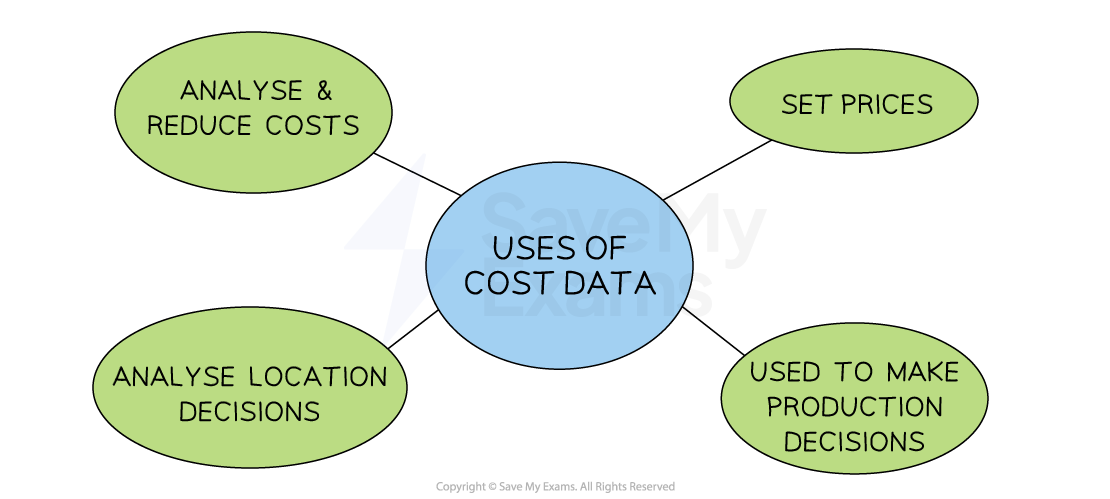
1. To reduce costs
Accurate cost data can help a business identify if their costs are too high
An important way to improve profit is to reduce costs
Fixed costs may be reduced by relocating to cheaper business premises, reducing salaries for workers, spending less on promotional activities or seeking lower-priced utility providers
Variable costs may be reduced by sourcing cheaper materials, buying raw materials in bulk, or outsourcing distribution to a third party business
E.g., Many businesses sell their products using Amazon which manages the packaging and shipping of items, usually at a cost much lower than the business itself could achieve
Businesses must carefully consider the impacts of reducing costs on customer service, quality and speed of delivery
Paying lower salaries to staff may mean that employees have fewer customer service skills or experience
Cheaper raw materials and components may lead to worsening quality
2. To set prices
Costs play an important role in the determination of selling prices
They are a crucial part of making, or increasing profit
E.g., If the average cost of making a cake is $3 and the business wants to make $1 profit on each cake sold, it will need to charge a price of $4
3. To make production decisions
If the cost of producing a product is higher than the revenue it generates, the business will make a loss
It will need to decide whether to continue making the product or stop
This decision depends on various factors including
Whether the product has just been launched on the market, in which case the sales revenue may increase in future
Whether the fixed costs will still have to be paid
4. To make location decisions
Property rental or the purchase of premises can be a substantial monthly cost
Some locations are cheaper than others
A business must weigh up the cost of the location against other important factors such as transport links, proximity to customers and availability of a workforce