StudyDeck

The Use of Technology in the Production of Goods & Services

Exam code: 7115
Written by: Ashika|Reviewed by: Caroline Carroll|Updated 2 July 2026

The impact of technology on production methods

The impact of technology on production methods

  • Technology has changed how businesses produce goods and services

  • It can make production faster, cheaper and more accurate, but also comes with some challenges

Advantages and disadvantages of technology in production

Advantages

Disadvantages

  • Increased speed and efficiency

    • Machines and automation can produce goods faster than humans, especially in flow production

  • Lower labour costs

    • Automation reduces the need for large numbers of workers, especially unskilled labour

  • Greater accuracy and consistency

    • Technology improves product quality by reducing human error

  • Greater flexibility

    • Modern technology allows quick changes between batches or designs

  • High initial costs

    • Buying and installing new machinery or software can be expensive for small businesses

  • Training required

    • Workers may need new skills to operate machines or software, which takes time and money

  • Risk of unemployment

    • Replacing workers with machines may lead to job losses, especially in labour-intensive industries.

  • Dependence on technology

    • A breakdown in machines or systems can stop production entirely and cause delays

Computer-aided manufacture (CAM)

Computer-aided manufacture (CAM)

  • Computer-Aided Manufacture (CAM) is the use of computers to control and assist with production activities
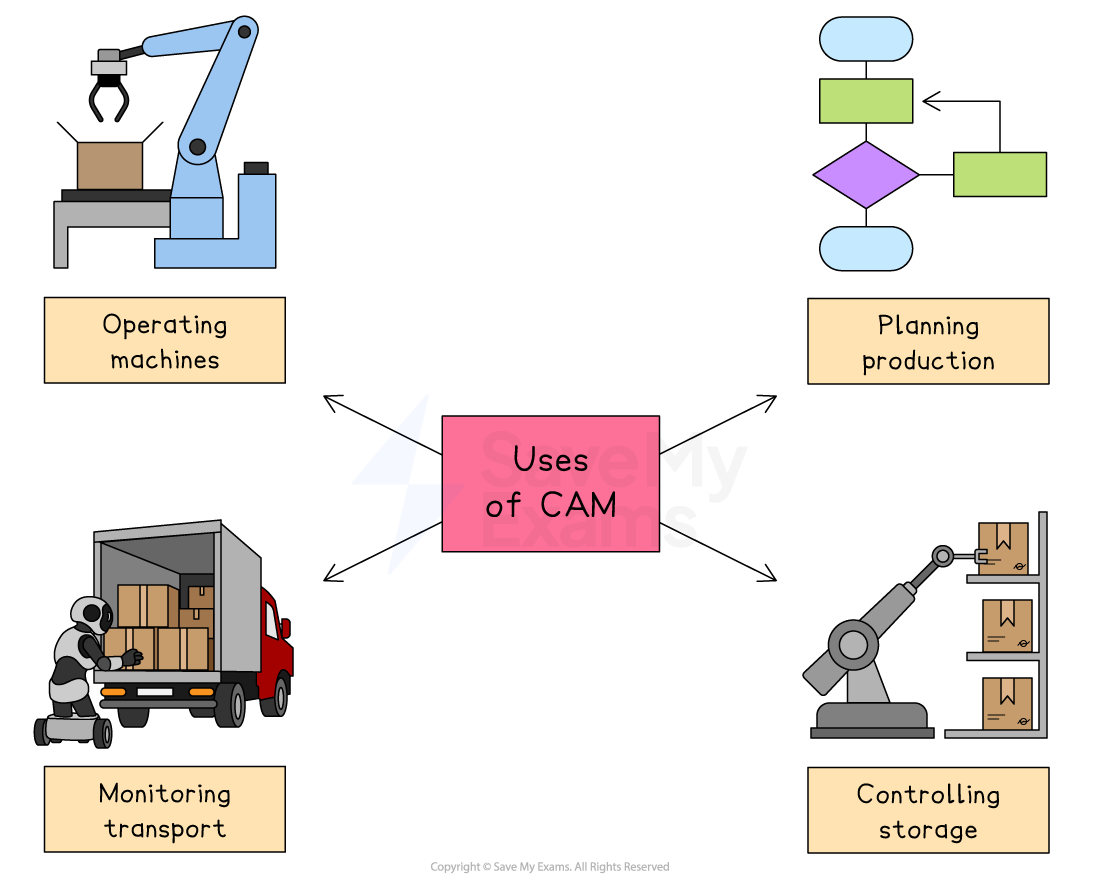
Flowchart illustrating uses of CAM: operating machines, planning production, monitoring transport, and controlling storage with icons.
CAM can be used to operate machines, plan production, monitor transport and control storage

Uses of computer-aided manufacture

Operating machines

  • CAM controls machinery such as cutters, drills or robotic arms, ensuring tasks are completed quickly, accurately, and with consistent quality

Planning production schedules

  • CAM software helps plan when and how products will be made, reducing delays and making sure resources are used efficiently

Monitoring transport

  • CAM systems can track the movement of materials and products, helping ensure they reach the right stage of production on time

Controlling storage

  • CAM helps manage inventory by tracking how much stock is available, where it is stored, and when new materials need to be ordered

3D printing

3D printing

  • Digital designs are uploaded and the 3D printer produces the product with minimal labour costs

  • Digital printers have been used to print car engines, houses, food and replacement limbs

The impact of 3D printing on production

Impact

Explanation

Cost

  • Traditional methods need expensive tooling and machinery, which is a high upfront cost for small businesses

  • 3D printing reduces costs as no special tools are required

Productivity

  • Traditional production has long lead times due to set-up and tooling, causing delays

  • 3D printing is faster with minimal lead times, allowing quicker response to customer demand and faster product launches

Quality

  • 3D printing produces detailed, high-quality items with greater accuracy

  • Traditional methods may struggle with complex designs

Flexibility

  • 3D printing allows small, low-cost production runs tailored to specific customer needs

  • Traditional production is less suited to customisation