Freefall
Acceleration of Free Fallvideo
Acceleration of Free Fall
In the absence of air resistance, all objects fall with the same acceleration
This is called the acceleration of freefall (this is also sometimes called acceleration due to gravity)
acceleration of free fall = g = 9.81 m/s2
Galileo's free fall experiment
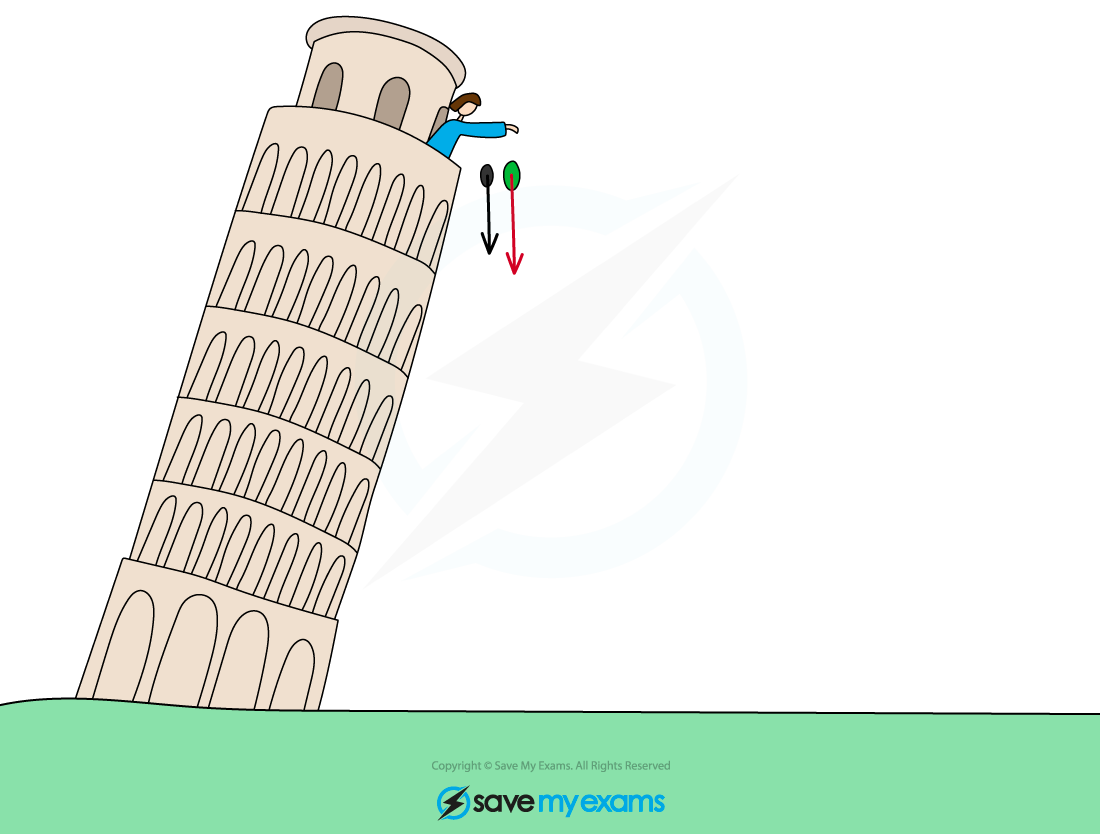
In the absence of air resistance, Galileo discovered that all objects (near Earth's surface) fall with an acceleration of about 9.8 m/s2
This means that for every second an object falls, its velocity will increase by 9.8 m/s
The symbol g also stands for the gravitational field strength, and can be used to calculate the weight of an object using its mass:
weight = mass × gravitational field strength
W = mg
Terminal Velocity
Terminal Velocity
Falling Objects without Air Resistance
In the absence of air resistance, all objects falling in a uniform gravitational field, fall with the same acceleration, regardless of their mass
So long as air resistance remains insignificant, the speed of a falling object will increase at a steady rate, getting larger the longer it falls for.
Free fall with constant acceleration
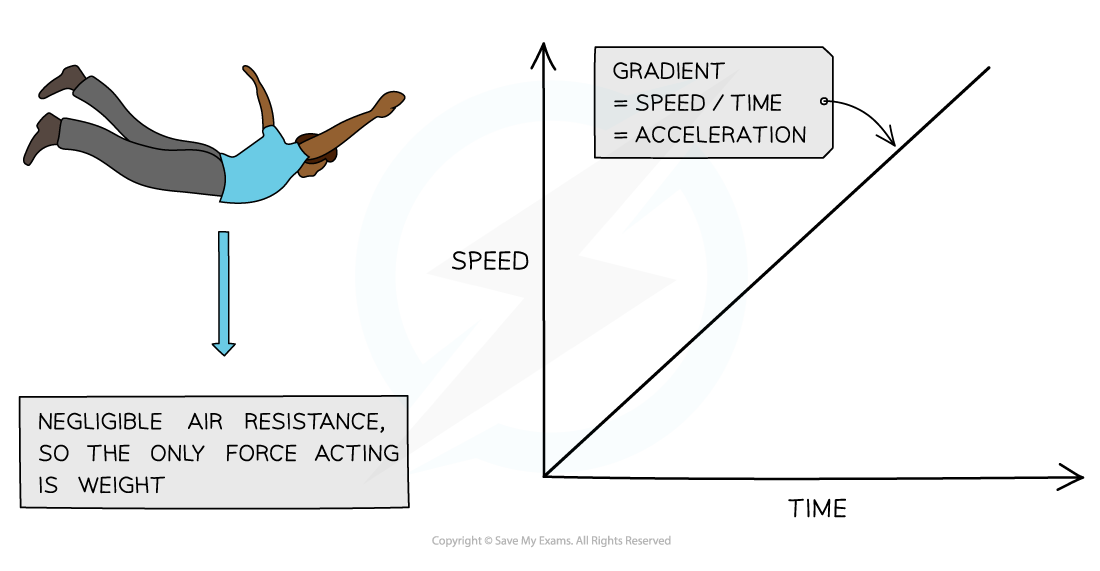
In the absence of air resistance objects fall with constant acceleration
Falling Objects with Air Resistance
Objects falling through fluids (fluids are liquids or gases) in a uniform gravitational field, experience two forces:
Weight (due to gravity)
Friction (such as air resistance)
A skydiver jumping from a plane will experience:
A downward acting force of weight (mass × acceleration of freefall)
An upward acting force of air resistance (frictional forces always oppose the direction of motion)
The force of air resistance increases with speed. This is illustrated in the image below:
Change in resultant force on a skydiver
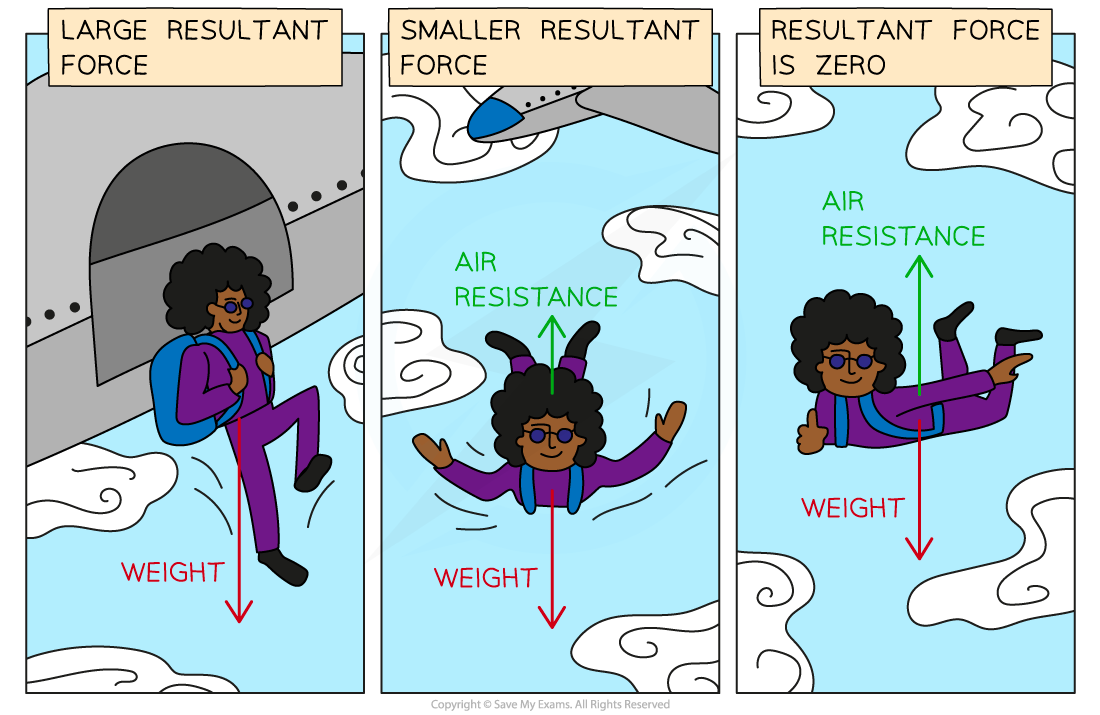
Debbie initially accelerates downwards due to her weight. The upwards air resistance increases as she falls until it eventually grows big enough to balance the weight force
Initially, the upwards air resistance is very small because the skydiver isn't falling very quickly
Therefore, there are unbalanced forces on the skydiver initially
As the skydiver speeds up, air resistance increases, eventually growing large enough to balance the downwards weight force
Once air resistance equals weight, the forces are balanced
This means there is no longer any resultant force
Therefore, the skydiver's acceleration is zero - they now travel at a constant speed
This speed is called their terminal velocity
When the skydiver opens the parachute, the air resistance increases
This is due to the increased surface area of the parachute opening
The upward force of air resistance on the skydiver increases, slowing the acceleration of the skydivers fall
The skydiver decelerates
Eventually, the forces balance out again, and a new slower terminal velocity is reached
Speed-time graph for a skydiver
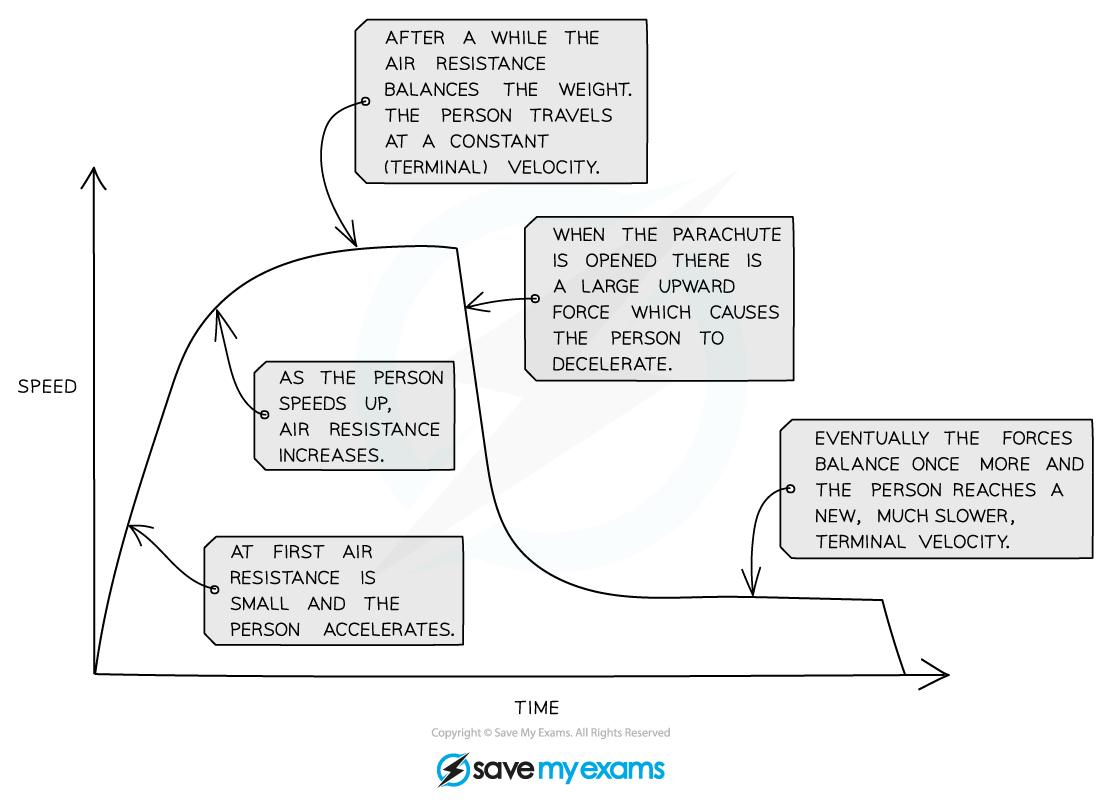
Graph showing how the velocity of a skydiver changes during the descent