Newton's Second Law
Newton's Second Lawvideo
Newton's Second Law
Newton's second law of motion states:
The acceleration of an object is proportional to the resultant force acting on it and inversely proportional to the object's mass
Newton's second law explains the following important principles:
An object will accelerate (change its velocity) in response to a resultant force
The bigger this resultant force, the larger the acceleration
For a given force, the greater the object's mass, the smaller the acceleration experienced
Examples of Newton's Second Law
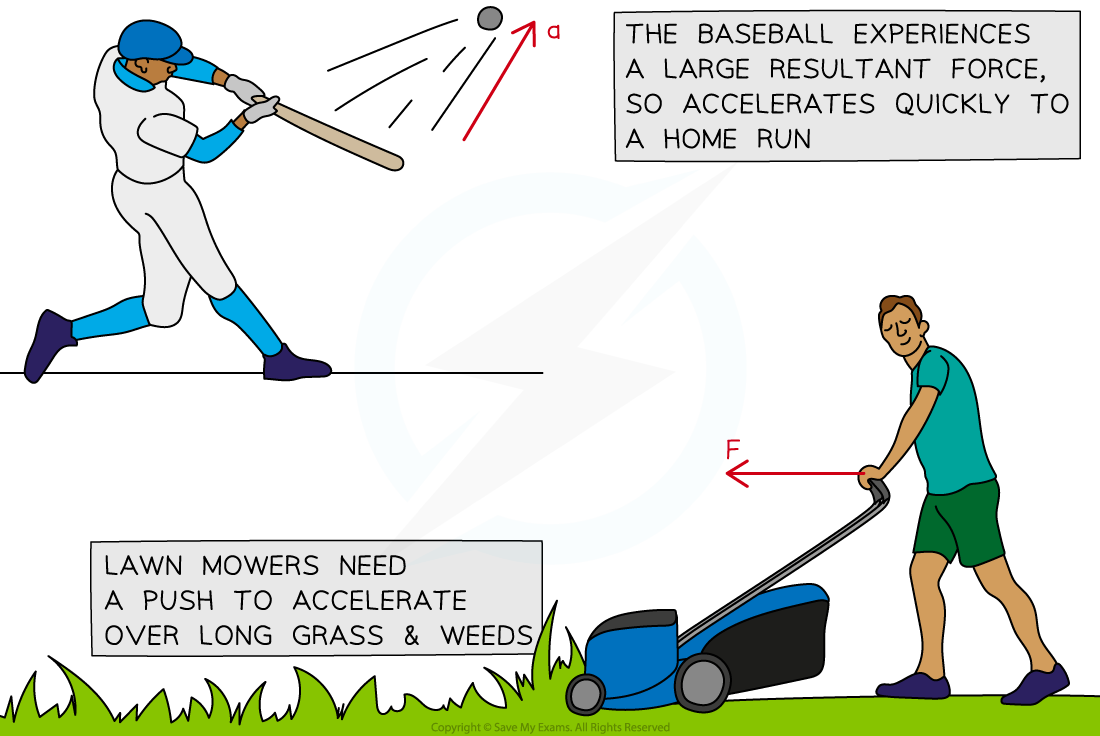
Objects like baseballs and lawnmowers accelerate when a resultant force is applied on them. The size of the acceleration is proportional to the size of the resultant force
Calculations Using Newton's Second Law
Calculations Using Newton's Second Law
Newton's second law can be expressed as an equation:
F = ma
Where:
F = resultant force on the object in Newtons (N)
m = mass of the object in kilograms (kg)
a = acceleration of the object in metres per second squared (m/s2)
The force and the acceleration act in the same direction
This equation can be rearranged with the help of a formula triangle:
Equation Triangle for Newton's Second Law
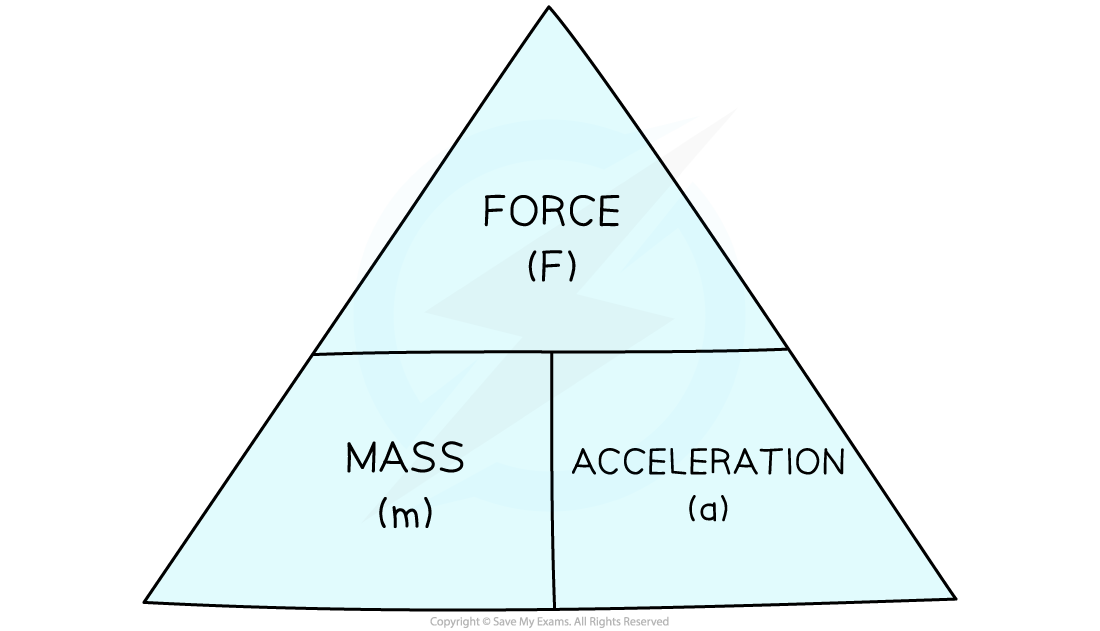
Force, mass, acceleration formula triangle; you can use this if you need support with the rearrangement until you feel able to do it on your own