Moments
Momentsvideo
Moments
As well as causing objects to speed up, slow down, change direction and deform, forces can also cause objects to rotate
An example of a rotation caused by a force is on one side of a pivot (a fixed point that the object can rotate around)
This rotation can be clockwise or anticlockwise
Pivot Point on a Metal Bar
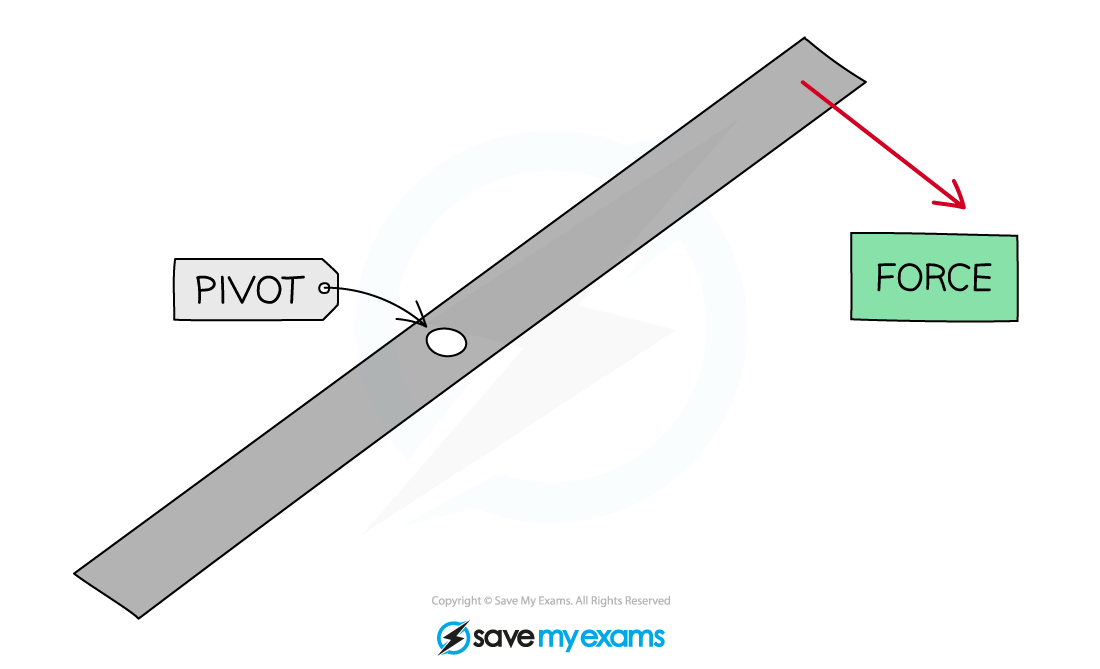
The force will cause the object to rotate clockwise about the pivot
A moment is defined as:
The turning effect of a force about a pivot
The size of a moment is defined by the equation:
M = F × d
Where:
M = moment in newton metres (Nm)
F = force in newtons (N)
d = perpendicular distance of the force to the pivot in metres (m)
Moment of a Spanner
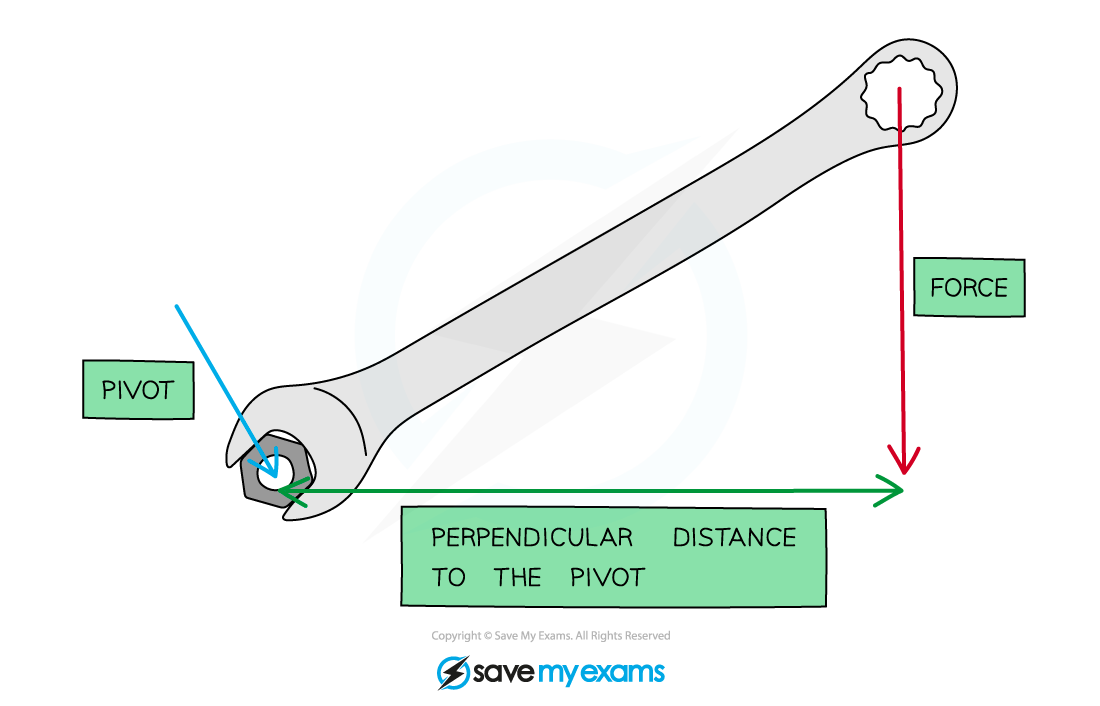
The moment depends on the force and perpendicular distance to the pivot
This is why, for example, the door handle is placed on the opposite side to the hinge
This means for a given force, the perpendicular distance from the pivot (the hinge) is larger
This creates a larger moment (turning effect) to make it easier to open the door
Opening a door with a handle close to the pivot would be much harder, and would require a lot more force
Some other examples involving moments include:
Using a crowbar to prize open something
Turning a tap on or off
A wheelbarrow
Scissors