Investigating Force & Extension
Investigating Springsvideo
Investigating Springs
When forces are applied to materials, the size and shape of the material can change
The method below describes a typical procedure for carrying out an investigation into the properties of a material
Experimental Set-Up to Measure the Extension of a Spring
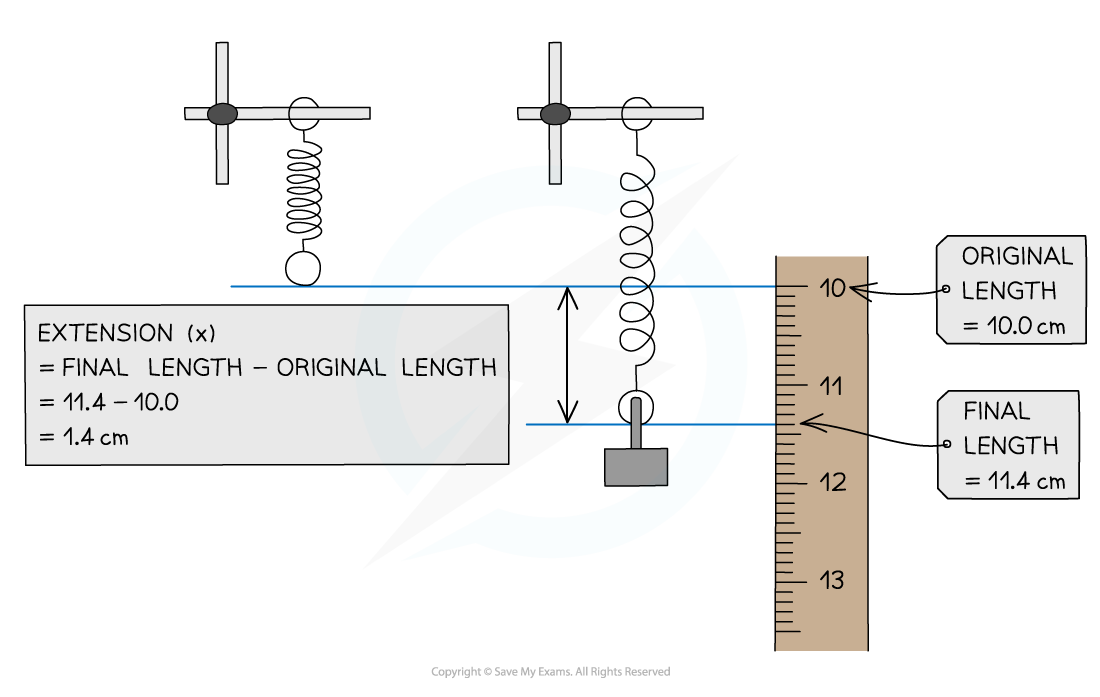
To measure the extension of a spring, masses are hung from the spring and the extension of the spring is measured with a ruler
Set up the apparatus as shown in the diagram
A single mass (0.1 kg, 100g) is attached to the spring, with a pointer attached to the bottom, and the position of the spring is measured against the ruler
The mass (in kg) and position (in cm) are recorded in a table
A further mass is added and the new position measured
The above process continues until a total of 7 masses have been added
The masses are then removed and the entire process repeated again, until it has been carried out a total of three times, and averages can then be taken
Once measurements have been taken:
The force on the spring can be found by multiplying the mass on the spring (in kg) by 9.81 N/kg (the gravitational field strength)
The extension of the spring can be found by subtracting the original position of the spring from each of the subsequent positions
Finally, a graph of extension (on the y-axis) against force (on the x-axis) should be plotted
Force-Extension Graph

A graph of force against extension for a metal spring