Momentum & Impulse
Momentum
Momentum
An object with mass that is in motion has momentum which is defined by the equation:
momentum = mass × velocity
p = mv
Where:
p = momentum in kilogram metre per second (kg m/s)
m = mass in kilograms (kg)
v = velocity in metres per second (m/s)
This means that an object at rest (i.e v = 0) has no momentum
Momentum keeps an object moving in the same direction, making it difficult to change the direction of an object with a large momentum
Since velocity is a vector this means that the momentum of an object also depends on its direction of travel
This means that momentum can be either positive or negative
If an object travelling to the right has positive momentum, an object travelling in the opposite direction (to the left) will have negative momentum
Momentum of a Tennis Ball
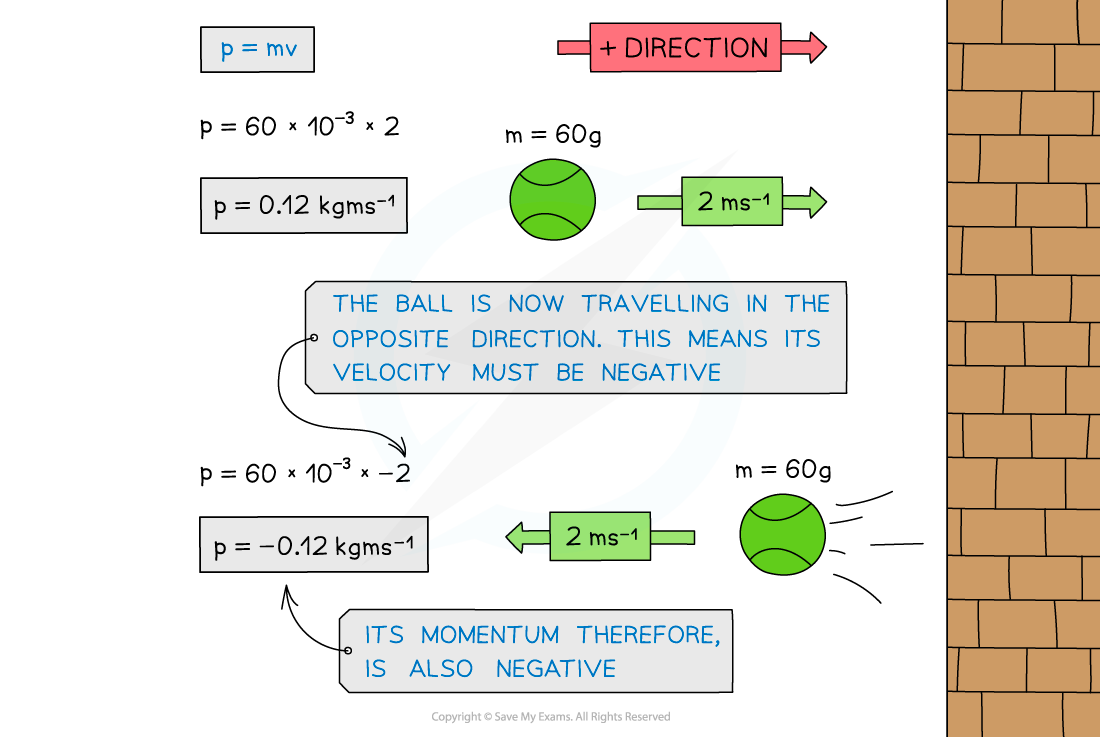
The tennis ball's momentum is negative when it moves in the opposite direction to which it initially was travelling in
Therefore, the momentum of an object will change if:
The object accelerates (speeds up) or decelerates (slows down)
Changes direction
Its mass changes
Conservation of Momentumvideo
Conservation of Momentum
The principle of conservation of momentum states that:
In a closed system, the total momentum before an event is equal to the total momentum after the event
A closed system means the energy within the system is constant and there is an absence of external forces (e.g. friction)
In other words:
The total momentum before a collision = The total momentum after a collision
A system is a certain number of objects under consideration
This can be just one object or multiple objects
Since momentum is a vector quantity, a system of objects moving in opposite directions (e.g. towards each other) at the same speed will have an overall momentum of 0 since they will cancel out
Momentum is always conserved over time
The diagram below shows two masses m with velocity u and M at rest (ie. zero velocity)
Momentum of Masses Before and After a Collision
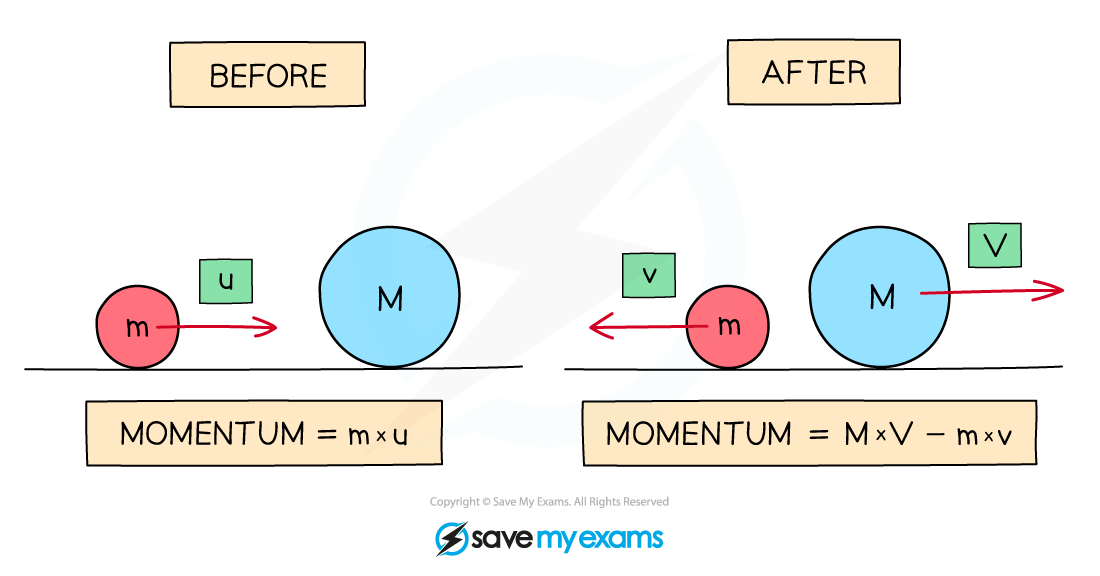
The momentum of a system before and after a collision
Before the collision:
The momentum is only of mass m which is moving
If the right is taken as the positive direction, the total momentum of the system is m × u
After the collision:
Mass M also now has momentum
The velocity of m is now -v (since it is now travelling to the left) and the velocity of M is V
The total momentum is now the momentum of M + momentum of m
This is (M × V) + (m × -v) or (M × V) – (m × v)