Newton's First Law
Newton's First Lawvideo
Newton's First Law of Motion
Newton's 1st law of motion states:
Objects will remain at rest, or move with a constant velocity unless acted on by a resultant force
This means if that:
A stationary object will remain stationary
An object moving with a constant velocity will continue to move at that constant velocity
Unless the object is acted upon by a resultant force
Conversely, that means that if an object is at rest, or has a constant velocity, no resultant force can be acting on it
Remember that a constant velocity means:
No change in speed
No change in direction
Applying Newton's First Law
Newton's first law is used to explain why things move with a constant (or uniform) velocity
If the forces acting on an object are balanced, then the resultant force is zero
The velocity (i.e. speed and direction) can only change if a resultant force acts on the object
Examples of Objects with Uniform Velocity
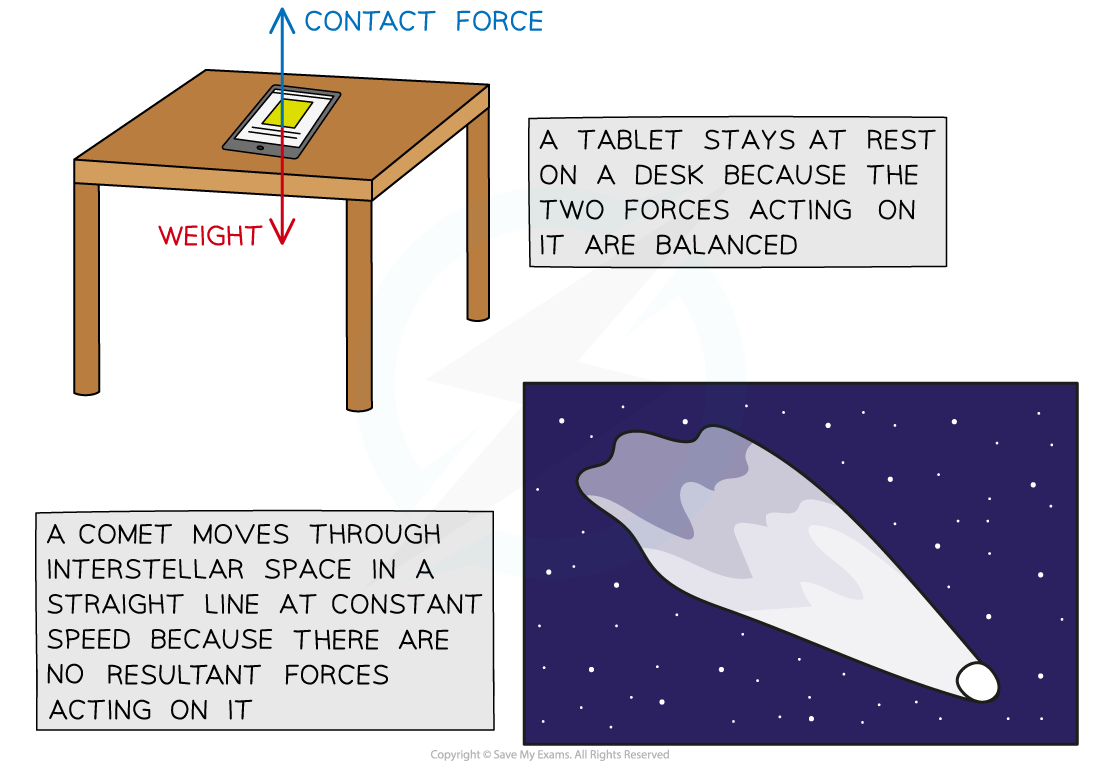
Constant velocity can only be achieved when the forces on an object are balanced - in other words, when the resultant force is zero