Newton's Third Law
Newton's Third Lawvideo
Newton's Third Law
Newton's third law of motion describes the effects of the forces involved when two different objects interact with one another
This is different to Newton's first and second laws, which describe the effects of forces acting on a single object
Newton's third law of motion states:
Whenever two bodies interact, the forces they exert on each other are equal and opposite
The pair of forces exerted by the interacting objects are known as force pairs
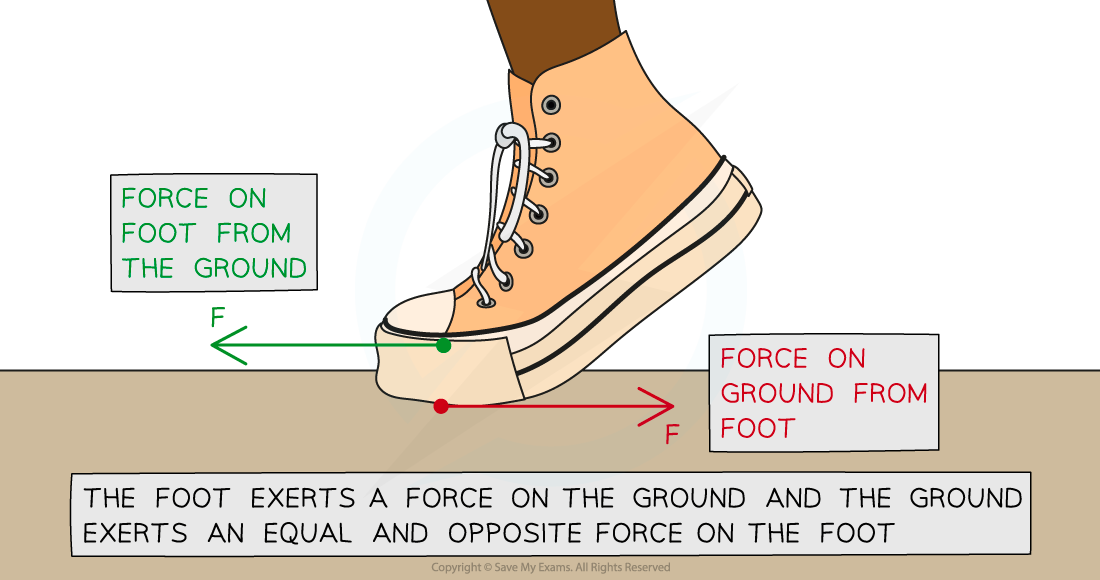
Newton's third law explains the forces that enable someone to walk
The foot and the ground are the two objects interacting
The foot exerts a push force on the ground
The ground exerts a push force on the foot
The forces are equal in magnitude and opposite in direction
Example of Newton's Third Law
Recognising Newton's third law
Use the following three rules to help you identify a third law pair:
The two forces in a third law pair act on different objects
The two forces in a third law pair always are equal in size but act in opposite directions
The two forces are always the same type: weight, reaction force, etc.
If you are struggling to name the force, just describe it as a push or pull force