Resultant Forces
Types of Force
Types of Force
A force is defined as:
A push or a pull that acts on an object due to the interaction with another object
Forces can affect bodies in a variety of ways:
Changes in speed: forces can cause bodies to speed up or slow down
Changes in direction: forces can cause bodies to change their direction of travel
Changes in shape: forces can cause bodies to stretch, compress, or deform
Different forces
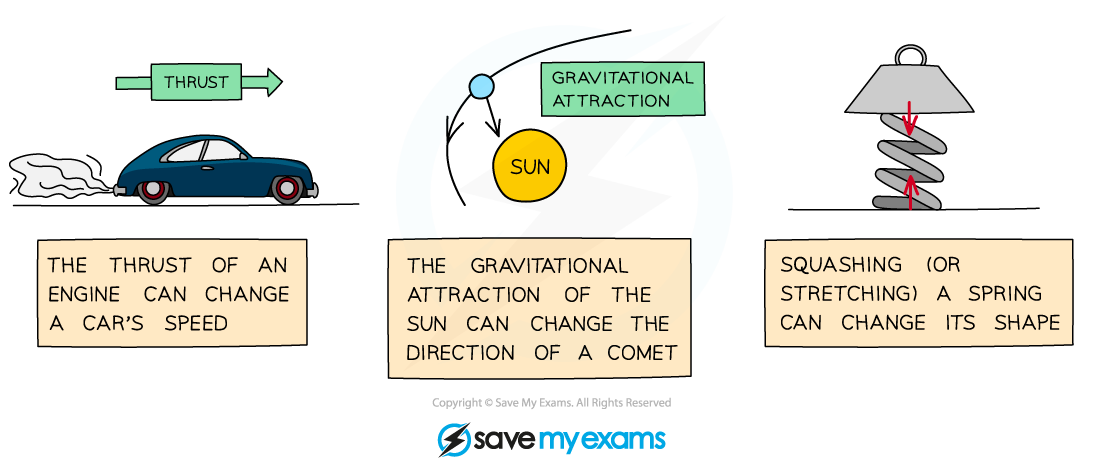
The effects of different forces on objects
Tension
Tension is:
The force experienced by a cable, rope, or string when pulled, hung, rotated or supported
This is normally labelled as T on free body diagrams
Tension force on a Picture Frame
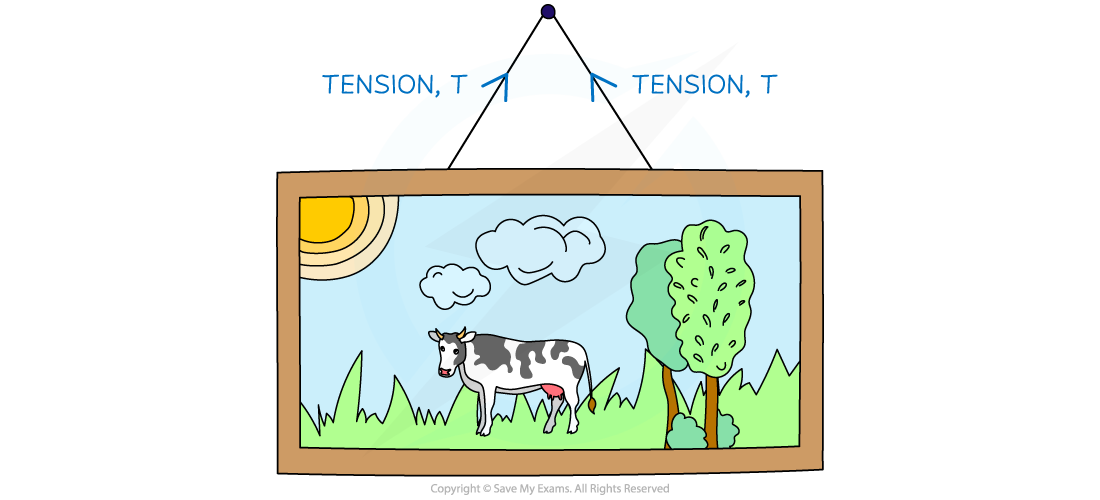
Tension always acts away from the mass
Normal Contact Force
The normal contact force is:
The force arising when an object rests against another object acting at a 90° angle to the plane of contact
It is sometimes also referred to as the reaction force
This is normally labelled as N or R on free body diagrams
This force arises from Newton's Third Law
Normal Contact Force
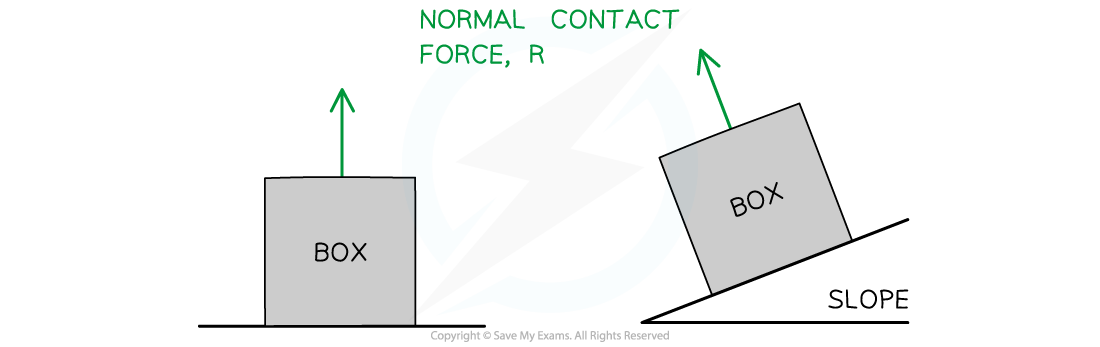
Normal contact force is the force with which a surface pushes against an object. The normal contact force always acts perpendicularly to the surface
Upthrust
Upthrust is:
The upward buoyancy force acting on an object when it is in a fluid
Upthrust can occur in liquids and gases
Upthrust on a Boat
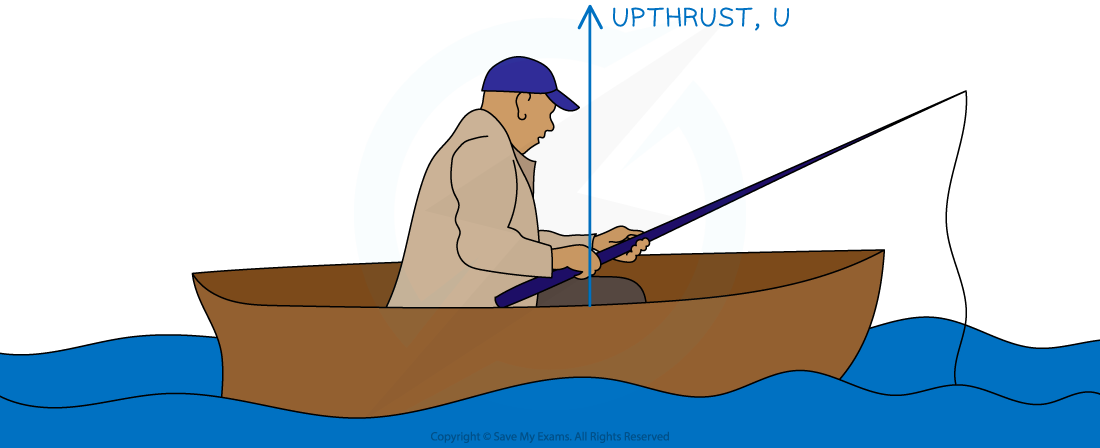
Upthrust always acts upwards
Friction
Friction is:
The force that arises when two surfaces are in contact with each other
Friction always opposes the motion
This is normally labelled as F or Fr on free body diagrams
Force of Friction Acting on a Car
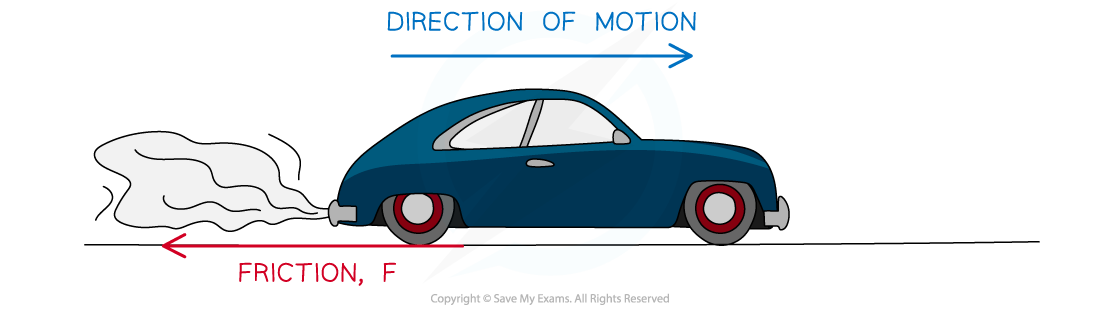
Friction always acts at the point where the objects are in contact, and in the opposite direction to the direction of motion
Identifying Forces Acting on an Object
Identifying Forces Acting on an Object
Free body diagrams are useful for modelling the forces that are acting on an object
Each force is represented as a vector arrow, where each arrow:
Is scaled to the magnitude of the force it represents
Points in the direction that the force acts
Is labelled with the name of the force it represents
Free body diagrams can be used:
To identify which forces act in which plane
To resolve the net force in a particular direction
Force Diagrams of a Mass on a Spring, and a Parachuter
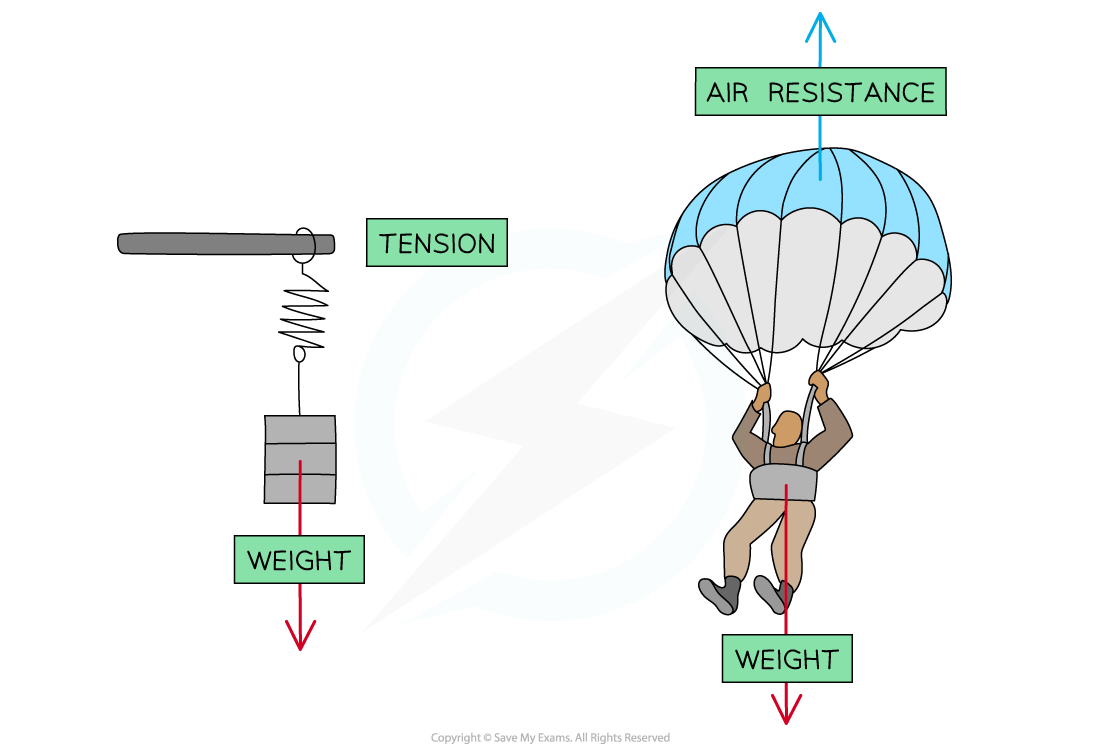
Free body diagrams can be used to show the various forces acting on objects
Resultant Forces on a Straight Line
Resultant Forces on a Straight Line
A resultant force is a single force that describes all of the forces operating on a body
When many forces are applied to an object they can be combined (added) to produce one final force which describes the combined action of all of the forces
This single resultant force determines:
The direction in which the object will move as a result of all of the forces
The magnitude of the final force experienced by the object
The resultant force is sometimes called the net force
Forces can combine to produce
Balanced forces
Unbalanced forces
Balanced forces mean that the forces have combined in such a way that they cancel each other out and no resultant force acts on the body
For example, the weight of a book on a desk is balanced by the normal force of the desk
As a result, no resultant force is experienced by the book, the book and the table are equal and balanced
Balanced Forces Acting on a Book at Rest on a Table
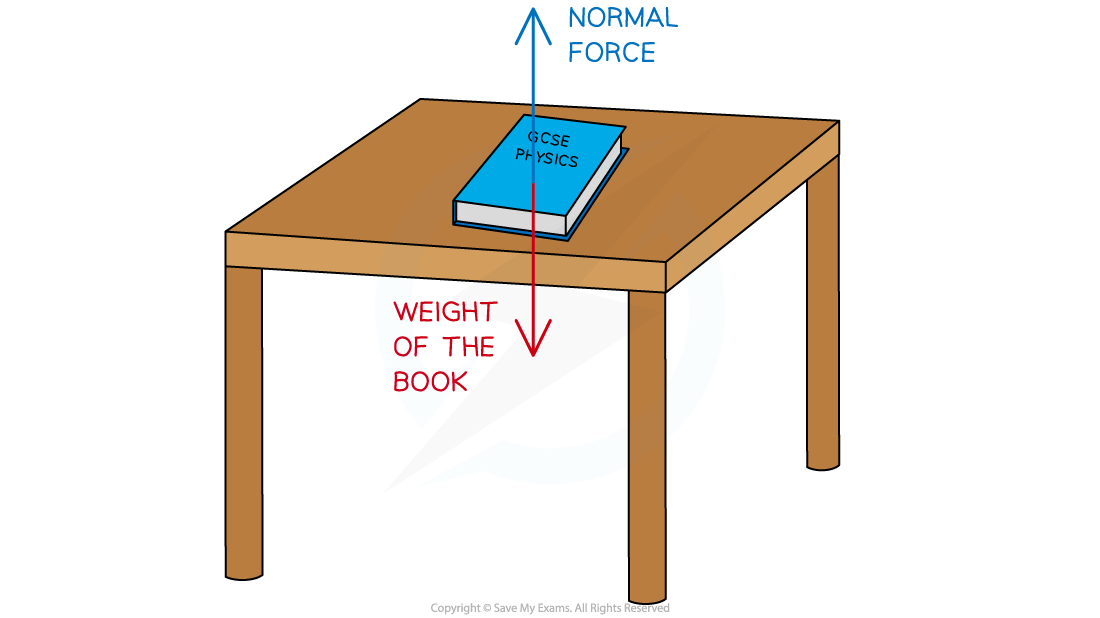
The upward acting normal contact force is equal to the force of weight, therefore the forces acting on the book are balanced
Unbalanced forces mean that the forces have combined in such a way that they do not cancel out completely and there is a resultant force on the object
For example, imagine two people playing a game of tug-of-war, working against each other on opposite sides of the rope
If person A pulls with 80 N to the left and person B pulls with 100 N to the right, these forces do not cancel each other out completely
Since person B pulled with more force than person A the forces will be unbalanced and the rope will experience a resultant force of 20 N to the right
Unbalanced Forces in a Game of Tug-of-War
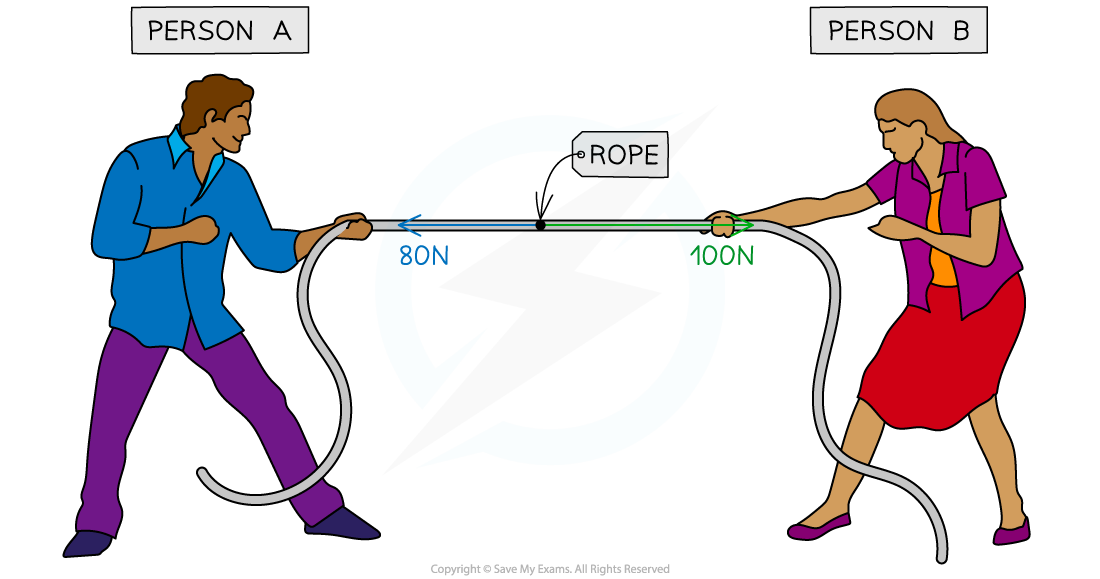
The force exerted on the rope by Person B is greater than the force exerted on the rope by Person A, therefore the forces acting on the rope are unbalanced
Resultant forces can be calculated by adding or subtracting all of the forces acting on the object
Forces working in opposite directions are subtracted from each other
Forces working in the same direction are added together
If the forces acting in opposite directions are equal in size, then there will be no resultant force – the forces are said to be balanced
Resultant Forces on Different Objects
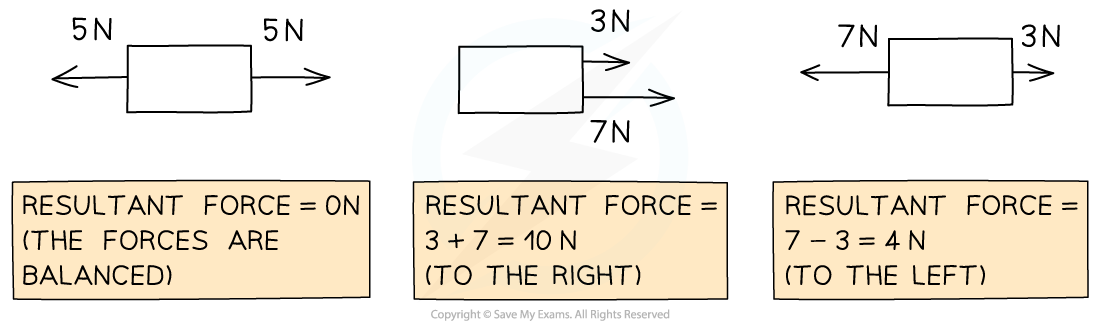
The resultant force is the net force acting on the object when all the individual forces have been added and the directional components accounted for
Imagine the forces on the boxes as two people pushing on either side
In the first scenario, the two people are evenly matched - the box doesn't move
In the second scenario, the two people are pushing on the same side of the box, it moves to the right with their combined strength
In the third scenario, the two people are pushing against each other and are not evenly matched, so there is a resultant force to the left