Impulse
Impulsevideo
Impulse
When a resultant (unbalanced) force acts on a mass, the momentum of that mass will change
The impulse of a force is equal to that force multiplied by the time for which it acts:
impulse = force × change in time
impulse = FΔt
The change in momentum of a mass is equal to the impulse provided by the force:
impulse = change in momentum
impulse = FΔt = Δp
Change in momentum can also be described as:
Δp = Δ(mv)
Δp = mv − mu
Where:
m = mass in kg
v = final velocity in m/s
u = initial velocity in m/s
Therefore:
impulse = FΔt = Δp = mv − mu
An example in everyday life of impulse is when standing under an umbrella when it is raining, compared to hail (frozen water droplets)
When rain hits an umbrella, the water droplets tend to splatter and fall off it and there is only a very small change in momentum
However, hailstones have a larger mass and tend to bounce back off the umbrella, creating a greater change in momentum
Therefore, the impulse on an umbrella is greater in hail than in rain
This means that more force is required to hold an umbrella upright in hail compared to rain
Impulse of Rain & Hail Stones
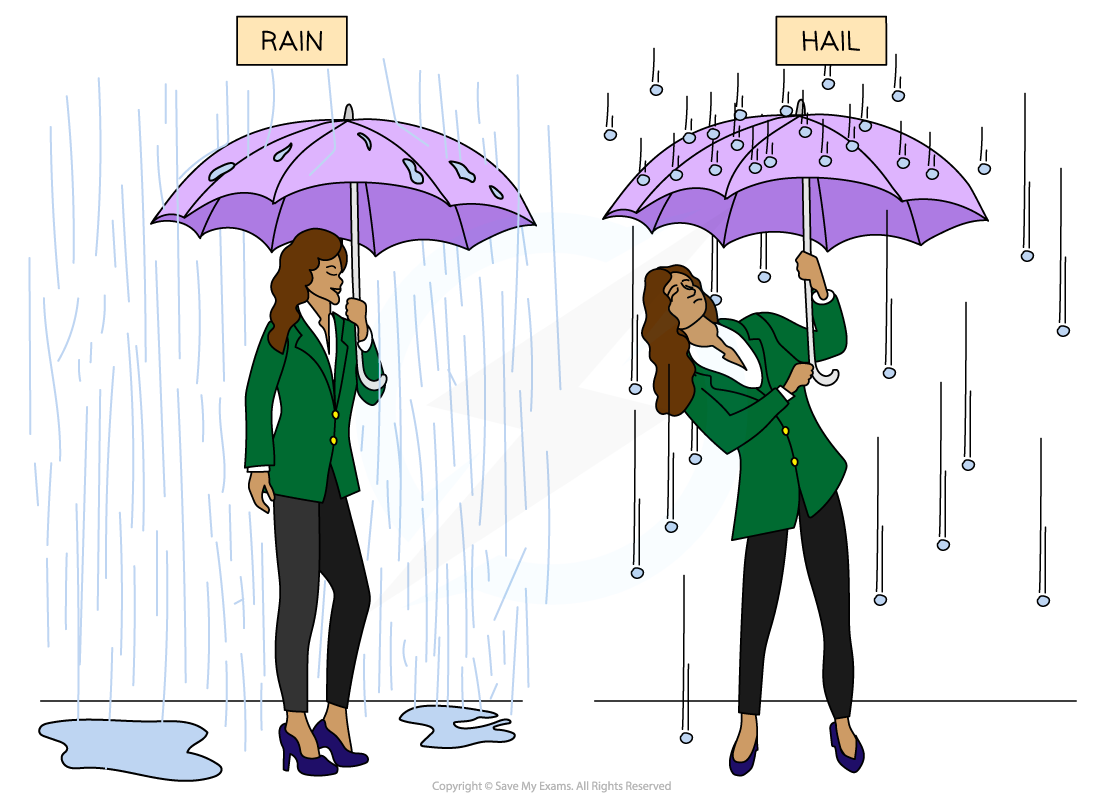
Since hailstones bounce back off an umbrella, compared to water droplets from rain, there is a greater impulse on an umbrella in hail than in rain
Force & Momentum
Force & Momentum
Force can also be defined as the rate of change of momentum on a body
The change in momentum is defined as the final momentum minus the initial momentum
These can be expressed as follows:
Where:
F = force in newtons (N)
Δ (Greek letter delta) = change in
p = momentum in kilogram metres per second (kg m/s)
t = time in seconds (s)